Key Takeaways
- Speed matters for marketing teams: Flint generates production-ready landing pages in minutes while Framer requires 30+ minutes of manual design work per page, making Flint the clear choice for teams running multiple campaigns simultaneously
- Brand consistency without design expertise: Flint's proprietary brand extraction technology automatically captures your design system from your existing website, while traditional builders like Framer and Webflow require manual recreation of brand elements
- GTM tool integration separates platforms: Only Flint offers direct integration with Claude, Clay, and workflow automation tools through its MCP and API, enabling programmatic page creation from CRM data and ad platforms
- Proven marketing ROI vs. design flexibility: Flint customers report 50% CAC reduction and 3x conversion increases, while Framer focuses on design quality metrics
- Different tools for different jobs: Use Framer for your portfolio or homepage design; use Flint for scaling ad landing pages and ABM campaigns
The Website Builder Market in 2026
The website builder market has expanded significantly, with options ranging from designer-focused tools to AI-powered platforms built for specific use cases. Framer serves designers well with its Figma-like interface and animation capabilities. But marketing teams at companies like Cognition, Modal, and Graphite have found that purpose-built landing page platforms deliver faster time-to-market and measurable business results.
1. Flint: AI-Powered Landing Pages for Marketing Teams
Flint stands as the purpose-built solution for B2B SaaS marketing teams needing to launch landing pages without waiting on design or engineering resources. Unlike general website builders, Flint focuses exclusively on marketing page velocity with built-in conversion optimization.
Key Features
- Proprietary brand extraction that automatically captures your complete design system from your existing homepage URL
- MCP integration connecting with Claude Code for orchestrating hundreds of pages from data sources like Clay, Airtable, and Meta ad platforms
- API integration connecting with Zapier, Relay.app, and custom systems for programmatic page generation
- Built-in CRO capabilities where Flint's agents are trained on the latest best practices of conversion rate optimization
- Production-ready technical SEO including server-side rendering, robots.txt, sitemap.xml, and llms.txt for AI engine optimization
- Direct editing through click-and-type interfaces without code
Pricing Structure
- 14-day free Pro trial with no credit card required
- Starter and Pro plans with transparent self-serve pricing
- 20% annual billing discount
- Enterprise tier with custom pricing
Why Marketing Teams Choose Flint
The platform addresses a specific market gap. Marketing teams traditionally choose between speed (DIY builders producing off-brand results) and quality (agency work requiring months and significant investment). Flint delivers both through AI-powered automation that maintains brand fidelity while operating at software speed.
Customer results demonstrate material business impact. Graphite achieved 50% CAC reduction and influenced seven figures of ARR through Flint-built ad pages. 11x reported 3x conversion rate increases and 20% conversion boosts on initial pages. Modal achieved number-one rankings on both Google and ChatGPT for key queries within days of launch.
Users can also apply website brand updates across all pages in Flint quickly. LangChain applied rebrand across 17 pages in two hours, demonstrating the platform's efficiency for maintaining brand consistency at scale.
With Flint's API and MCP integrations, teams can create landing pages directly from Claude, their CRM, Zapier, or existing agent tech workflows. This makes Flint ideal for ABM marketing campaigns where you need dozens or hundreds of targeted pages.
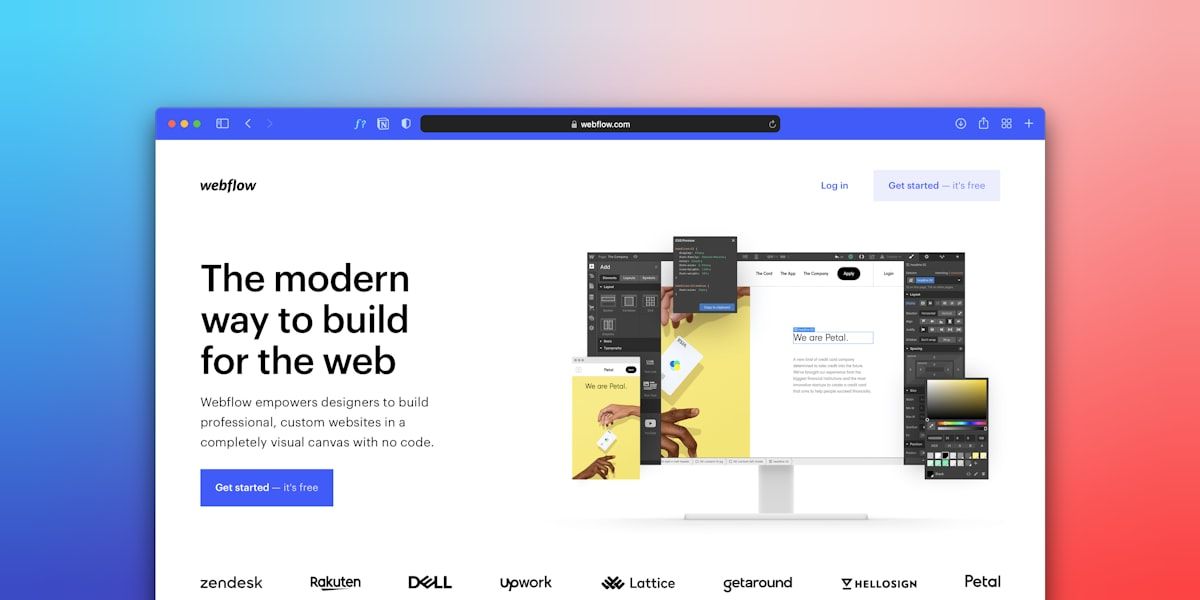
2. Webflow
Webflow serves designers and agencies requiring maximum design flexibility with robust content management capabilities. The platform powers 590,000+ websites and offers pixel-perfect control over every element.
Key Features
- Advanced CMS with relational data support
- Clean semantic HTML/CSS code output
- Native e-commerce capabilities
- 270+ native integrations plus 300+ marketplace apps
- Strong SEO tools and controls
Learning Curve Considerations
Webflow offers exceptional design power but requires weeks to master. Many companies hire dedicated Webflow specialists or engage agencies for projects. For marketing teams needing rapid iteration, this complexity creates bottlenecks.
For a detailed breakdown of how the platforms compare, see the Flint vs Webflow comparison.
3. Wix
Wix targets small businesses and beginners with its intuitive drag-and-drop interface. With 304 million+ users, Wix offers the largest template library among website builders.
Key Features
- 800+ templates across industries
- Native e-commerce and payment processing
- Built-in SEO tools
- App marketplace with 800+ integrations
- Mobile-optimized templates
Best Use Cases
Wix works well for small businesses needing a straightforward online presence. The platform's ease of use comes with design constraints. For B2B SaaS marketing teams requiring brand consistency and rapid deployment, Wix's template-based approach may produce generic results.
For more details, see the Flint vs Wix comparison.
4. Squarespace
Squarespace serves creatives, photographers, and portfolio-focused businesses with elegant templates and straightforward setup. The platform hosts 4.4 million+ sites globally.
Key Features
- Award-winning design templates
- Built-in e-commerce functionality
- Integrated analytics
- Email marketing tools
- Scheduling and booking features
Considerations for Marketing Teams
Squarespace excels at beautiful, template-driven websites for portfolios and small businesses. The platform's design-first approach works well for brand websites but offers fewer options for rapid landing page iteration or programmatic page generation at scale.
5. Mutiny
Mutiny has evolved into an AI agent for GTM teams that creates customer-facing assets across the entire funnel. The platform now extends well beyond website personalization into broader AI-native creation for sales and marketing teams.
Key Features
- On-brand AI that ingests your company website to build a brand profile including logos, colors, fonts, and CTA styling
- Creation of landing pages, ABM pages, proposals, pitch decks, case studies, and microsites
- AI research capabilities for understanding target company priorities and pain points
- Blueprint templates for common marketing and sales use cases
- Hybrid editing through chat-style prompts and direct WYSIWYG editing
- Account context adaptation for messaging, logos, and case studies
Platform Focus
Mutiny targets enterprise GTM teams seeking polished customer-facing assets without design, content, or engineering dependencies. The platform supports both campaign workflows and sales-oriented functionality. Assets are hosted within Mutiny, with paid plans allowing custom subdomains.
6. WordPress
WordPress powers over 40% of websites, making it the dominant content management system globally. The open-source platform offers unlimited customization through themes and plugins.
Key Features
- Complete design and functionality control
- 60,000+ plugins available
- Self-hosting options for full ownership
- Extensive SEO capabilities through plugins
- Large developer community
Technical Requirements
WordPress offers maximum flexibility but requires technical knowledge or developer resources for custom implementations. Marketing teams without dedicated technical support often face bottlenecks when launching new landing pages or updating existing content.
7. Unbounce
Unbounce focuses specifically on landing page creation with conversion optimization features. The platform serves marketers running paid advertising campaigns who need dedicated landing pages.
Key Features
- Drag-and-drop landing page builder
- A/B testing capabilities
- Dynamic text replacement for ad matching
- Smart Traffic AI for automatic visitor routing
- Pop-ups and sticky bars
- Integration with major marketing tools
Landing Page Focus
Unbounce provides dedicated landing page tools with conversion optimization features. The platform works well for teams comfortable with manual page building who need A/B testing capabilities. For teams requiring brand extraction, programmatic generation, or GTM tool integration, Flint offers more comprehensive automation.
Flint vs. Traditional Builders: When Speed and Scale Matter
The fundamental difference between Flint and traditional website builders like Framer and Webflow comes down to purpose and workflow.
Design-First vs. Marketing-First
Traditional builders prioritize design flexibility and pixel-perfect control. Framer offers excellent animations and Figma-like interfaces. Webflow provides advanced CMS capabilities. Both require significant time investment for each page.
Flint prioritizes marketing velocity. The platform generates pages in minutes rather than hours or days. Pages went live within days versus typical months-long timelines.
Manual vs. Programmatic
Traditional builders require manual creation of each page. For marketing teams running ABM campaigns or keyword-targeted advertising, this creates a bottleneck. Building 50+ landing pages manually takes weeks.
Flint supports bulk page creation from spreadsheets or data sources. Upload a CSV of target accounts or ad groups, and Flint generates customized pages for each row. Amigo.ai created 341 tailored pages with one click.
Standalone vs. Integrated
Framer and Webflow operate as standalone design tools. They connect to marketing tools through plugins but lack native GTM workflow integration.
Flint's MCP connection lets teams create, edit, and publish landing pages through natural conversation in Claude and other MCP-compatible tools. The API enables page creation from workflow tools like Clay, Relay.app, Zapier, and n8n. This integration enables automated page generation triggered by CRM events or ad platform data.
For teams evaluating their options, the Flint vs Framer comparison provides detailed feature breakdowns.
Frequently Asked Questions
What are the main differences between Framer and Flint?
Framer is a design-focused website builder with Figma-like interfaces and sophisticated animation capabilities, targeting designers creating portfolio sites and brand websites. Flint is a landing page platform built for marketing teams, featuring automatic brand extraction, programmatic page generation, and GTM tool integration. Framer requires 30+ minutes of manual design work per page, while Flint generates production-ready pages in minutes. Choose Framer for design-intensive projects requiring pixel-perfect control; choose Flint for marketing velocity and scale.
Can Flint create pages for other purposes beyond landing pages, like full websites?
Flint specializes in landing pages for marketing campaigns, ABM initiatives, ad landing pages, comparison pages, and SEO/SEM pages. The platform works alongside existing CMS tools like Webflow, Framer, or WordPress. Many teams deploy Flint on subdomains or folders for landing pages while maintaining their main website on an incumbent platform. This complementary approach lets marketing teams move fast on campaign pages without disrupting the main website infrastructure.
How does Flint ensure brand consistency without manual design work?
Flint's proprietary brand extraction technology automatically captures your complete design system from your existing homepage URL. This one-time setup extracts brand tokens, component libraries, typography, spacing, colors, and interactive elements. The platform then applies this brand identity to new pages at scale, producing pages that appear hand-crafted by your design team. This contrasts with template-based builders that swap colors into generic layouts.
Is Flint suitable for small businesses or primarily for large enterprises?
Flint serves fast-growing B2B SaaS and AI companies ranging from seed-stage startups to venture-backed companies. The platform particularly resonates with companies having small marketing teams that need to execute strategies matching larger competitors' output. With a 14-day free Pro trial requiring no credit card and a Startup Program offering 20% discounts through partner VCs, Flint provides accessible entry points for growing companies.
What kind of technical expertise is needed to use Flint effectively?
Flint requires no technical expertise for basic use. Marketing teams interact through a chat interface, describing requirements while Flint produces conversion-optimized layouts matching their brand system. Direct editing capabilities allow refinement through click-and-type interfaces without code. For advanced automation, the MCP integration works with Claude, and the API connects with workflow tools, enabling both non-technical marketers and developers to leverage the platform.
Does Flint integrate with existing marketing tools like HubSpot or Salesforce?
Yes. Flint automatically migrates existing analytics scripts from customer websites, supporting Google Tag Manager, Segment, Google Analytics, HubSpot, and Salesforce. The API integration enables programmatic page generation from CRM data, while MCP integration allows page creation through Claude conversations. This means marketing teams can trigger landing page creation directly from their existing tech stack without manual intervention.