Key Takeaways
- Bolt.new projects generally can't be imported directly into Webflow's visual Designer; treat migration as a rebuild of layouts, components, and CMS structure rather than a 1:1 transfer
- Migration timelines vary substantially by scope; a small marketing site may take several weeks, while sites with extensive CMS content, custom functionality, or significant redesign work can take considerably longer
- Missing or incorrect redirects are among the most common and damaging causes of post-migration SEO problems; build a redirect map before touching any tools
- Flint extracts key elements of your existing site's design system and generates campaign pages using them, without manual style recreation
- A hybrid architecture works for many teams: Webflow for the core marketing site, Flint for high-volume campaign landing pages, and optionally Bolt for application functionality
Understanding the Shift: From AI Builder to Production Platform
Bolt.new excels at rapid prototyping. You describe what you want, and the AI generates a functional site or application in minutes. This speed makes it well-suited for validating product-market fit or testing messaging with early customers.
However, AI builders have characteristics that surface as companies scale:
- CMS workflow gap: Bolt can build custom, database-backed content systems using Bolt Database or Supabase, but it doesn't provide the same turnkey visual CMS editing workflow as Webflow; structured content and marketer-friendly publishing may need custom implementation
- SEO behavior depends on implementation: How a Bolt project renders and indexes depends on the framework, rendering configuration, deployment, and metadata choices made during the build, not simply on the platform itself
- Design constraints: AI-generated aesthetics can look generic compared to hand-crafted brand experiences
- Marketing team bottlenecks: Launching new landing pages often requires technical involvement rather than marketer independence
The migration decision typically arrives when marketing needs outpace what the AI builder can deliver. Your team wants to publish content without developer queues, SEO performance matters for customer acquisition, and prospects expect a professional web presence that matches your product quality.
Common Challenges with Generic AI Builders
Technical debt can accumulate in AI-generated sites, and code structures optimized for rapid generation don't always align with long-term maintenance needs. Marketing teams can find themselves relying on engineering support for content updates that a dedicated CMS would let them handle directly.
Brand differentiation can also suffer. When multiple companies use the same AI builder with similar prompts, their sites can end up looking similar. Moving to a production platform gives marketing and design more direct control over every design element.
Why Webflow Excels as Your Production Web Development Platform
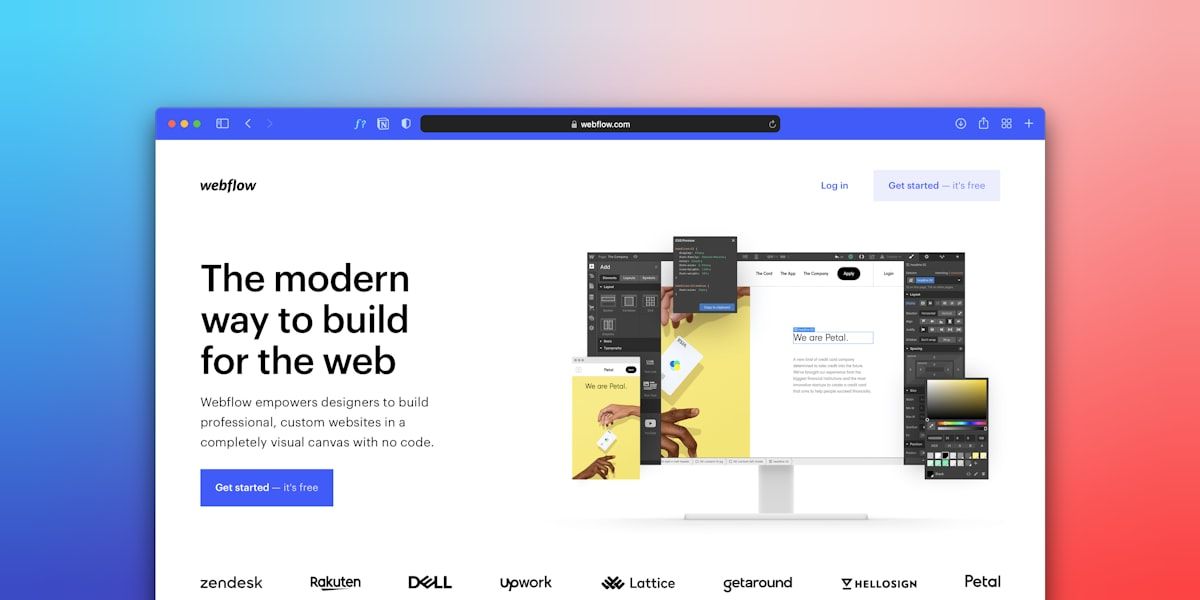
Webflow generates HTML, CSS, and JavaScript from a visual editor, giving marketing teams direct control over their web presence. The platform includes managed hosting, structured CMS capabilities, and an app ecosystem supporting many marketing tools.
Key advantages over AI builders include:
- Visual CMS architecture: Support for content collections with references and conditional visibility
- SEO controls: Meta tag management, 301 redirects, sitemap generation, and Open Graph configuration
- Designer/editor role separation: Designers control the design system while content editors publish without breaking layouts
- Extensible integrations: Analytics and marketing tools connect through built-in settings, Webflow Apps, APIs, embedded forms, custom code, and third-party automation services
Mastering Webflow: Resources for Your Team
The learning curve is moderate but manageable for teams with CSS fundamentals. Webflow University provides free training, and the community produces extensive tutorials covering specific use cases.
Consider the training investment when budgeting your migration. Professional migrations typically include team enablement, so your marketing staff can maintain the site independently after launch.
Transitioning Your Core Site: A Step-by-Step Webflow Guide
The migration process follows a structured sequence that helps prevent common pitfalls. Skipping phases or rushing timelines can lead to SEO issues, broken functionality, and extended cleanup work. The phases and week ranges below are illustrative; actual duration depends heavily on your site's scope.
Phase 1: Pre-Migration Audit
Before touching any tools, document your current state:
- Content inventory: List every page URL, its purpose, and whether it migrates to Webflow
- SEO baseline: Record current rankings, traffic, and top-performing pages
- Redirect map: Create a spreadsheet mapping old URLs to new URL structures
- Asset collection: Download images, videos, and documents for import
This phase does the most to determine migration complexity. Sites with straightforward content generally move faster than those with extensive CMS needs, custom functionality, or heavy integration requirements; scope your realistic timeline after completing this audit rather than before it.
Phase 2: CMS Architecture Design
Design your Webflow CMS structure before building:
- Define collections for each content type (blog posts, case studies, team members, resources)
- Map field types for each collection item
- Plan taxonomies for categories and tags
- Document relationships between collections
Start simple. Over-engineered CMS structures create maintenance headaches. Add complexity only when specific requirements demand it.
Phase 3: Webflow Build
Execute the build in this order:
- Global styles first: Typography, colors, spacing, and interactive states
- Component library: Reusable elements like buttons, cards, and navigation
- CMS templates: Collection pages and detail pages
- Static pages: Homepage, about, pricing, and other unique layouts
- Responsive design: Test across all breakpoints
Build on a staging subdomain (yoursite.webflow.io) throughout this phase. Avoid building directly on your production domain.
Phase 4: Content Migration and SEO Transfer
This phase makes or breaks your SEO performance:
- Import structured content via CSV files
- Transfer meta titles and descriptions exactly
- Implement 301 redirects for every changed URL
- Configure sitemap.xml and robots.txt
- Set up Open Graph tags for social sharing
The redirect map you created in Phase 1 becomes critical here. Missing or incorrect redirects are among the most common and damaging causes of post-migration SEO problems, so treat this mapping work as a priority rather than an afterthought.
Phase 5: Testing and Launch
Thorough QA helps prevent post-launch emergencies:
- Cross-browser testing (Chrome, Firefox, Safari, Edge)
- Mobile device testing across screen sizes
- Form submission verification
- Internal link checking (broken links hurt UX and SEO)
- PageSpeed comparison against pre-migration baseline
Launch during low-traffic hours when possible. Monitor DNS propagation, which can take anywhere from minutes to about 48 hours, verify SSL activation, and submit your new sitemap to Google Search Console soon after launch.
Phase 6: Post-Launch Monitoring
The weeks after migration require vigilance:
- Monitor Search Console regularly, especially early on
- Track 404 errors indicating missed redirects
- Compare Core Web Vitals against your baseline
- Fix issues as soon as they surface rather than letting them compound
Temporary ranking and traffic fluctuations can occur while Google recrawls and reprocesses changed URLs. The size and duration of any change varies by site, migration scope, crawl rate, URL mapping, and content parity, so a well-executed migration with accurate redirects can see relatively little disruption while others take longer to stabilize.
Unlocking Marketing Velocity with Flint Landing Pages
Migrating your core site to Webflow solves the production infrastructure problem. But marketing teams often encounter a new bottleneck: campaign-specific landing pages.
Every ad campaign, ABM initiative, and SEO keyword cluster can benefit from a dedicated landing page. Building these in Webflow requires design work, development time, and QA cycles, and the queue can grow faster than your team can deliver.
Flint fills this gap as a landing page builder built for marketing velocity. Rather than replacing your Webflow site, it operates as a complementary layer handling high-volume campaign pages while Webflow manages your core web presence.
Overcoming Design and Engineering Bottlenecks
Traditional workflows can force marketing teams to choose between speed and quality. DIY page builders produce off-brand results quickly. Agency or in-house builds maintain brand standards but take weeks.
Flint generates landing pages using conversion-oriented layouts and lets teams refine messaging, hierarchy, and calls to action. Marketing teams describe requirements through natural language or data inputs, and the platform produces draft layouts matching their brand system for review.
Flint's Brand Extraction: On-Brand Pages at Scale
Flint's core differentiator is its brand extraction technology. Point it at your existing website, and it extracts key elements of your design system:
- Brand tokens (colors, spacing, sizing)
- Typography hierarchy
- Button and link styles
- Header and footer patterns
- Recurring visual components
This setup enables subsequent pages to reflect your existing brand rather than a generic template. Because some components or layouts may live only on interior pages, it's worth reviewing the extracted system and providing references for anything important the scan missed.
Ensuring Brand Fidelity Across Campaigns
Brand consistency matters for conversion. Visitors arriving from ads expect the landing page to match the ad creative and your main site, and visual disconnects can create friction that reduces conversion.
Users can also update Flint's stored design system after a rebrand and apply the refreshed styles to existing pages. LangChain built 17 keyword-targeted pages in under two hours and later updated its Flint pages for a rebrand in a single afternoon, rather than manually rebuilding each page. Reviewing the resulting pages after a resync is still a good practice before publishing.
Programmatic Page Generation for Strategic Marketing Initiatives
Flint supports bulk and programmatic page creation from structured data, including spreadsheet-based workflows, its API, CRM triggers, and tools such as Clay. The setup and level of automation vary by workflow: a spreadsheet upload works differently than an API- or CRM-triggered flow.
Use cases span multiple marketing functions:
- ABM campaigns: Pages tailored to target account industries, pain points, and use cases
- Ad campaigns: Landing pages matched to specific ad groups and keywords
- SEO/SEM initiatives: Location-based pages, comparison pages, and industry-specific content
- Event marketing: Registration pages with consistent branding
According to Flint's Graphite results, the company reported seven figures of ARR influenced within six months, a 50%+ conversion-rate increase, and four competitor-comparison pages built in under 48 hours using campaign-matched landing pages.
Dynamic Content for Marketing Campaigns
Flint provides an MCP integration documented for use with Claude and Codex, along with an API for programmatic page creation. Other MCP clients may work where they support Flint's required connection and authentication model. Marketing teams can describe what they need in natural conversation, and Flint generates draft pages for review.
Flint's API can be used in workflows involving tools such as Clay, Airtable, and Relay. Availability and setup differ by tool; some workflows call Flint's API from an automation platform like Zapier or n8n rather than a native one-click connector, letting teams trigger page creation from CRM updates or advertising performance data with less manual page-building work.
Optimizing for AI Search: Beyond Traditional SEO with Flint
Search behavior is shifting. Beyond traditional Google rankings, answers now also appear in tools like ChatGPT, Google AI Overview, and Perplexity. Pages built only with traditional SEO in mind can miss this growing source of traffic.
Flint supports SEO- and GEO-focused landing-page workflows, including configurable metadata and Open Graph settings, server-side rendering, and semantic HTML structure. Teams should separately verify rendering, sitemap, and robots.txt behavior, image optimization, structured data, and any llms.txt implementation on their specific published pages rather than assuming every element is applied automatically by default. Check Flint's SEO landing pages documentation for implementation details.
Technical Foundations for AI Ranking
AI search engines evaluate content differently than traditional search, generally favoring clear answers, credible sourcing, and well-structured information. Flint's output is built with markup patterns aligned to these preferences, which can make content easier for search and retrieval systems to access and interpret. These practices don't guarantee rankings, citations, or inclusion in AI-generated answers, since that also depends on content quality, authority, and each engine's own retrieval behavior.
Built-in CRO capabilities: Flint's agents are trained on the latest best practices of conversion rate optimization. Pages are generated with conversion-oriented layout patterns and clear CTAs as a starting point, and teams should validate actual performance through their own analytics.
Integrating Flint with Your Existing Webflow Stack
Flint works alongside Webflow rather than replacing it. A typical deployment architecture looks like:
- yourbrand.com: Webflow (main marketing site)
- pages.yourbrand.com: Flint, available as self-service subdomain publishing
- yourbrand.com/lp/: Flint, available to Pro and Enterprise customers through a reverse proxy that may need infrastructure support
- app.yourbrand.com: Your product application (optionally kept on Bolt for functionality)
Seamlessly Connecting Marketing and Main Site Data
Flint supports Google Analytics and Google Tag Manager configuration by ID. Other tags for tools like Segment, HubSpot, and Salesforce can often be added through GTM. Existing tags can frequently be reused, but teams should still configure and validate analytics, consent, form events, and cross-domain attribution on the new Flint pages rather than assuming everything carries over automatically.
Visit Flint's analytics documentation for configuration details.
Flint hosts the pages it publishes, reducing the need to provision separate page-hosting infrastructure. Teams remain responsible for their Flint plan, domain or proxy setup, tracking, integrations, and ongoing QA.
Selecting the Right Website Builder for Your Business Needs
The right platform choice depends on your team's capabilities, timeline, and growth trajectory.
Choose Bolt.new when:
- You need an MVP launched this week
- You're validating product-market fit before investing in marketing infrastructure
- Your site is primarily application functionality rather than content marketing
Choose Webflow when:
- Your marketing site is a primary commercial asset
- You need structured CMS with a large volume of pages
- SEO and brand differentiation drive customer acquisition
- Marketing team independence from developers matters
Add Flint when:
- Campaign volume exceeds what your team can build manually
- Marketing velocity matters for competitive advantage
- You want brand consistency without the bottleneck of design review cycles
The hybrid approach works for many growing companies. Each platform handles what it does best, contributing to a web presence that scales with your business.
Why Flint Helps You Scale Campaign Landing Pages
After migrating your core site to Webflow, Flint can help maintain the campaign velocity that made AI builders attractive in the first place.
Traditional alternatives require real tradeoffs. Building campaign pages in Webflow means queueing behind other priorities, waiting for design resources, and extending timelines to weeks per page. Generic page builders can sacrifice brand quality for speed, creating disjointed experiences that hurt conversion rates.
Flint narrows this tradeoff through several key capabilities:
- Brand extraction: Capture key elements of your design language once, then apply them across pages
- Programmatic generation: Create batches of pages from structured data more quickly than building each one manually
- MCP and API integrations: Connect to Claude, Codex, Zapier, Airtable, Clay, and Relay for workflow automation
- SEO- and GEO-oriented infrastructure: Built with traditional search and AI answer engines in mind, subject to the verification steps outlined above
- Direct editing: Marketing teams refine content through click-and-type interfaces without code
The results speak through customer outcomes, reported by Flint's customers and specific to their own campaigns rather than typical or guaranteed results. According to Flint's customer case studies, LangChain built 17 keyword-targeted pages in under two hours and generated six figures of pipeline in roughly six weeks. Graphite reported seven figures of ARR influenced within six months and a 50%+ conversion-rate increase. Forus reported a 3x increase in paid-media conversions after building 14 landing pages in one month.
For marketing teams evaluating campaign velocity, the Flint vs Webflow comparison details how each platform serves different needs within a unified web strategy.
Frequently Asked Questions
What are the main advantages of migrating from an AI builder to a platform like Webflow?
Production platforms like Webflow provide SEO infrastructure, structured CMS capabilities, more direct design control, and marketing team independence from developers. AI builders excel at rapid prototyping but generally lack the visual CMS workflow depth needed for scaled marketing operations. Migration timelines vary significantly by scope, so plan your own timeline after a content and technical audit rather than assuming a fixed number of weeks.
How does Flint help keep new landing pages consistent with my existing brand?
Flint uses brand extraction technology to capture key elements of your design system from your existing website, including colors, typography, button and link styles, and header and footer patterns. Pages generated afterward apply these extracted elements as a baseline. When your brand updates, you can resync Flint's stored design system and apply the refreshed styles to existing pages, then review the results before publishing. LangChain demonstrated this by updating its Flint pages for a rebrand in a single afternoon.
Can Flint integrate with my current Webflow site and analytics tools?
Yes. Flint works alongside Webflow rather than replacing it. Deploy Flint pages on a subdomain, or on a path off your main domain if you're on a Pro or Enterprise plan using a reverse proxy. Flint supports Google Analytics and Google Tag Manager configuration by ID, and other tracking scripts for tools like Segment, HubSpot, and Salesforce can often be added through GTM. Flint hosts the pages it publishes, which reduces separate page-hosting infrastructure, though your team still manages your Flint plan, domain or proxy setup, and ongoing tracking configuration.
What types of marketing campaigns are best suited for Flint's programmatic page generation?
Flint supports high-volume campaign needs including ABM pages targeting specific accounts, ad campaign landing pages matched to keyword groups, SEO/SEM pages for location or industry targeting, comparison pages, and event registration pages. The platform accepts data from spreadsheets, CRMs, or workflow tools like Clay. Marketing teams can create larger batches of pages from structured data rather than building each one manually, with setup and automation varying by workflow.
How does Flint help with visibility in AI search tools like Google AI Overview?
Flint supports building pages with SEO- and GEO-oriented technical foundations, including server-side rendering, semantic HTML structure, and configurable metadata, and teams can verify sitemap, robots.txt, and structured-data setup for their specific pages. These practices can make content easier for search and retrieval systems to access and interpret, but they don't guarantee rankings or citations in tools like ChatGPT, Perplexity, or Google AI Overview, since that also depends on content quality, authority, and each engine's own retrieval behavior. Flint's built-in CRO capabilities mean Flint's agents are trained on the latest best practices of conversion rate optimization, giving pages a conversion-oriented starting point that teams should still validate through their own analytics.